
Granted Patents
This patent describes a system and method for enabling private network subscribers to roam onto public land mobile networks (PLMNs) when outside their private network coverage area. The key challenge it addresses is that private networks typically don’t have unique PLMN IDs, instead sharing generic codes like MCC=999, which makes traditional roaming arrangements difficult to implement.
The solution introduces a Roaming Identity Register (RIR) and Private Roaming Agent (PRA) to facilitate roaming between private and public networks. When a private network user equipment (UE) attempts to attach to a visited PLMN, the PLMN identifies it as a private network subscriber and queries the RIR. The RIR maintains a database mapping private network subscribers’ IMSIs to “Private Network Pointers” that identify their home networks. The RIR returns this pointer, allowing the visited PLMN to apply appropriate roaming policies and route signaling correctly.
The system works across both 4G LTE and 5G networks, with the PRA implemented either as an extension to a Diameter Edge Agent (DEA) in 4G or a Security Edge Protection Proxy (SEPP) in 5G. The patent details multiple implementation scenarios, including pure LTE networks, mixed LTE/5G deployments, and pure 5G setups with local breakout options. This enables mobile network operators to offer private network users fallback coverage on their public networks while maintaining proper routing and policy enforcement.
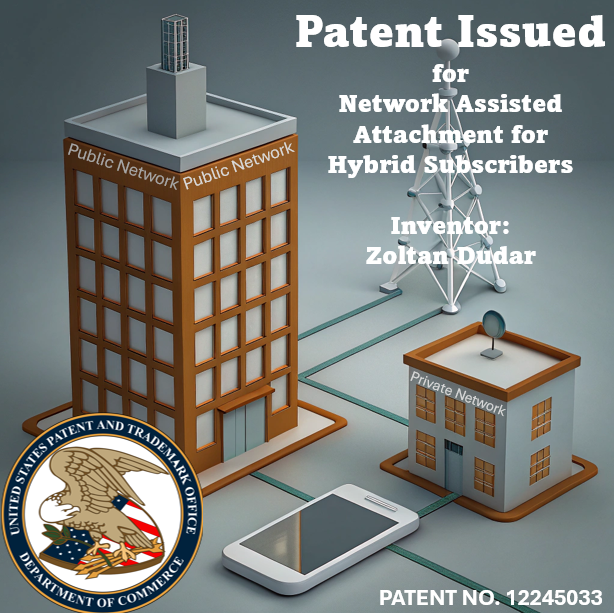
This patent describes a system and method for allowing mobile devices with a single SIM card to access multiple wireless networks using just one set of credentials. The innovation addresses a common limitation where devices with a single SIM can typically only access the network they’re subscribed to. The patent specifically focuses on scenarios where two networks have a business relationship (such as a public network and a private network operated by the same service provider) and want to allow subscribers of one network to easily access the other.
The patent outlines two main approaches for this cross-network access. In the first approach, a user equipment (UE) device connects to its home network (the one it’s subscribed to) and then accesses the second (private) network through that connection. While this works, it can introduce significant latency. The second, more innovative approach allows the UE to connect directly to the second (private) network, even though it doesn’t have credentials for that network. This works through a network-assisted authentication process where the second (private) network’s Unified Data Management (UDM) component reaches out to the home network’s UDM to verify the user’s credentials.
The patent also details the specific authentication mechanisms between networks, including how one network’s UDM can authenticate itself to another network’s UDM using public/private key encryption, nonces, and message authentication codes. This security framework ensures that cross-network authentication requests are legitimate and secure. The system is particularly beneficial for scenarios like enterprise private networks that want to allow their employees to access both public and private networks without requiring dual-SIM phones or managing multiple sets of credentials.
This patent introduces automatic application-level network slicing for private cellular networks. The technology detects which application is associated with a communication session, determines if it matches specific network slicing rules, and then classifies and assigns the traffic to an optimized network slice. This automation improves Quality of Experience without requiring manual configuration.
The system consists of an orchestrator device that distributes slicing rules, a traffic classifier that identifies applications through methods like VLAN IDs or traffic patterns, and databases that store application requirements. Implemented in private 5G networks with MEC environments, the technology enables specialized handling for different applications—from video streaming to medical monitoring—by automatically allocating appropriate network resources based on application needs.